

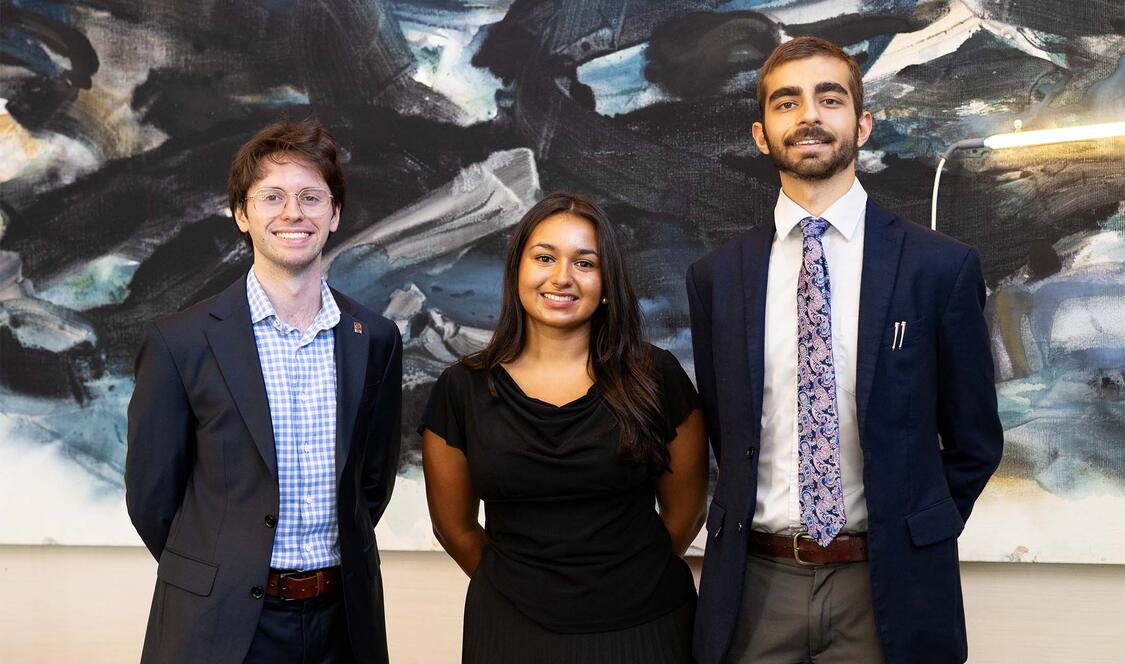
With each academic year, a new set of Woolley Athenaeum Fellows take on hosting duties of the prestigious speaker series at the Marian Miner Cook Athenaeum—affectionately known as the Ath—the heart of intellectual engagement at the College.
This year’s trio—Ambika (Bika) Gupta ’27, Jasper Langley-Hawthorne ’27, and Shivom Parihar ’28—introduce the speakers, spark head-table discussions, foster connections, and manage the post-talk Q&A sessions. It’s a rigorous job, and one highly coveted by CMC students who prize the constructive dialogue at the Ath’s core and personal engagement with experts who take the podium. Over the decades, guest speakers have included thought leaders and innovators; Pulitzer Prize winners and Nobel Laureates; diplomats and prominent physicians.
While their backgrounds and motivations to become Fellows vary, Gupta, Langley-Hawthorne, and Parihar share a commonality—their deep affinity for the Ath.
Learn more about each Fellow in our annual introductory Q&A below.
What motivated you to become an Ath Fellow?
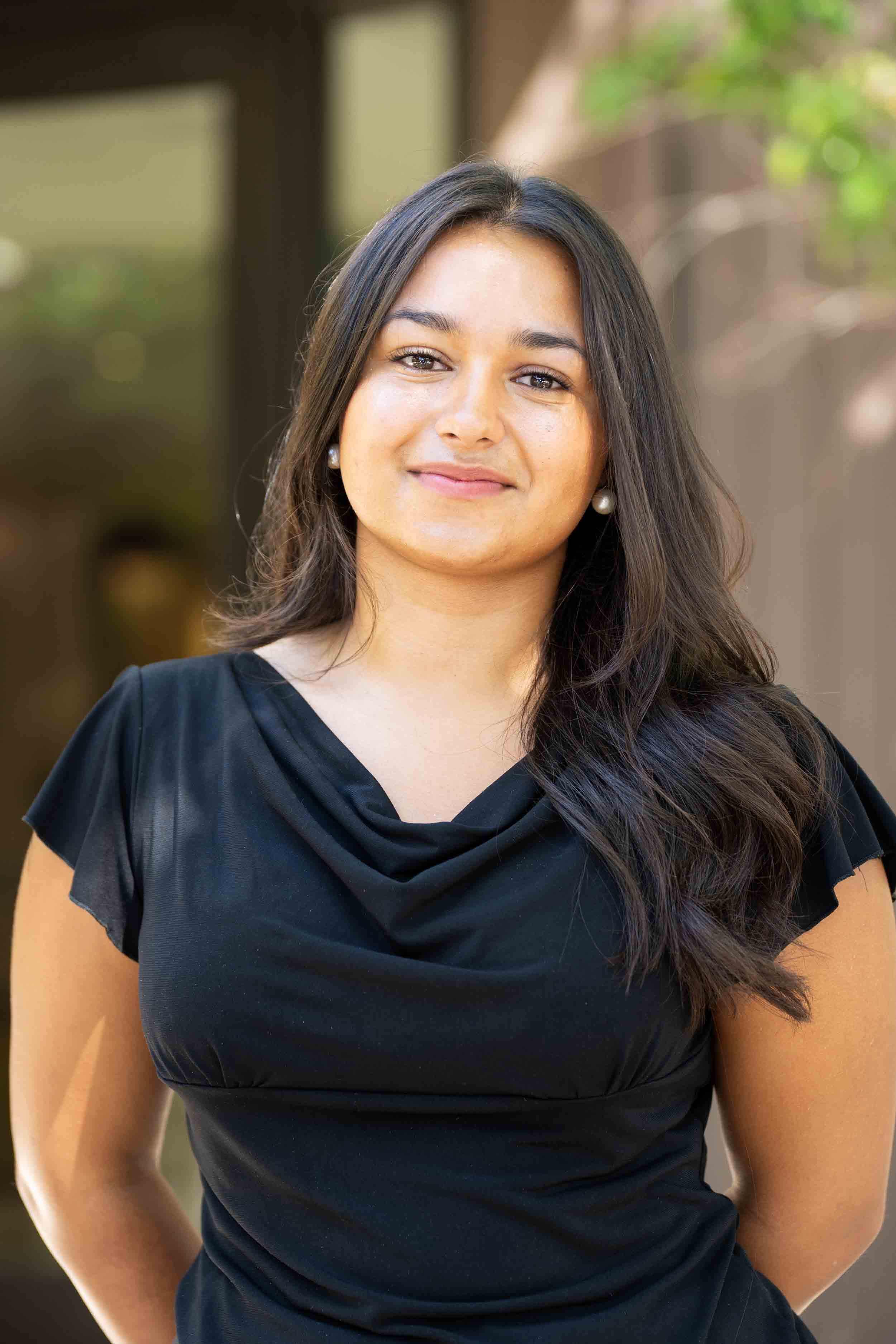
Ambika (Bika) Gupta ’27: Quite simple: I love the Ath. I have averaged an Ath a week since my freshman year. I love the appetizers, the conversation, and the general atmosphere. I love the chance to learn just for fun. The Ath helps keep the spirit of a liberal arts education alive at CMC. It’s a place where everyone attending is connected by a shared intellectual interest.
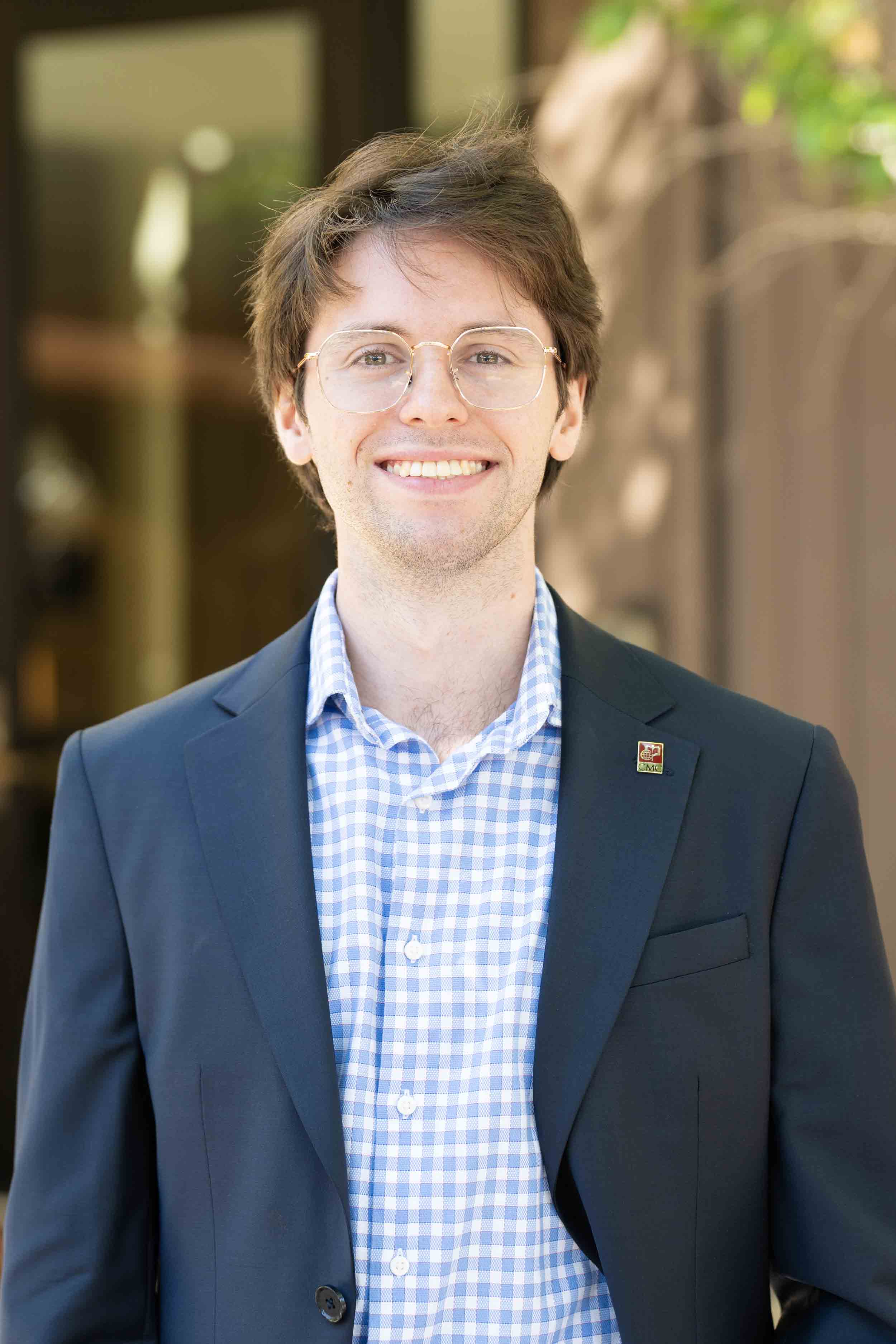
Jasper Langley-Hawthorne ’27: I became an Ath Fellow because I love and take pride in CMC’s ethos of constructive dialogue and responsible leadership, which I think are embodied in the institution of the Ath. I have learned so much attending Ath events and talking with the students, faculty, and speakers, and I hope I can enable that same experience for the next generation of CMC students.
My freshman year, I found that the 2023-2024 Ath Fellows were wellsprings for advice on campus, classes, and life, and I hope I can offer that to new students as well, even if it’s something as minor as helping them fix their tie (a practice in which I had help from my freshman year Ath Fellows a few too many times).
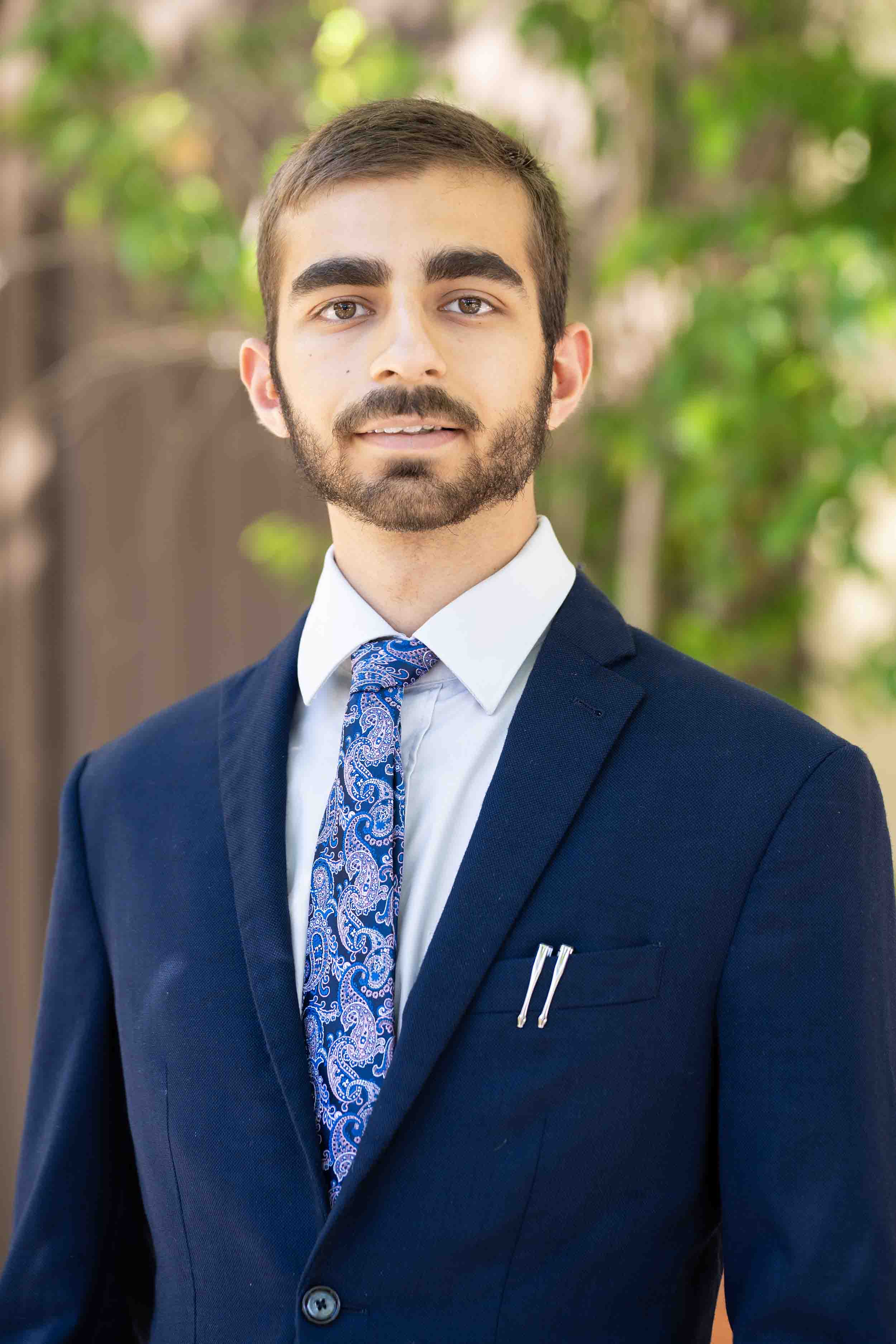
Shivom Parihar ’28: I came to the Ath so often (my record was six times in a week with lunch events included) that I felt I wouldn’t be giving back to this institution—that really makes CMC what it is for me—unless I tried to help create these worthwhile experiences for other students.
What do the three of you have in common?
Parihar: We have all written for The Forum, one of the best publications at the 5Cs! I think this testifies to another similarity we all have, we’re all broadly intellectually curious. Although we all study politics in our majors, we’re all glad to be present at a talk about the arts, science, and so many other subjects. Being able to cross that diversity of topics is what makes the Ath such a special part of CMC. I am so lucky to be joined by Bika and Jasper for all of it. I am in such awe at Bika’s passion for a principled approach to world politics and Jasper’s analytical mind.
A key component of Ath talks is the student-speaker Q&A. Why do you think having the opportunity to ask questions matters?
Gupta: Firstly, the Q&A offers students a chance to ask clarifying questions. The Ath aims to have leading experts distill their ongoing research into a 45-minute lecture, so the content can be challenging, as it should be. However, beyond clarification, the Q&A also offers a chance for students and community members to challenge the speaker—probe at where they felt the lecture had logical holes or something they felt required more nuance. Done correctly, everyone benefits and learns from an active Q&A.
Langley-Hawthorne: The Q&A allows students to engage directly with experts in politics, the social sciences, and business, and voice their disagreements in a productive outlet. In an age of diffuse and disconnected battles waged in comments sections online, I can’t stress enough the value of face-to-face Q&A for cultivating healthy discourse.
How does the speaker roster complement what you’re learning in the classroom at CMC?
Parihar: I think the speaker roster builds on it consistently. One speaker, Musa al-Gharbi, wrote a book we read in my polarization class with Professor (Calvin) TerBeek last semester, while others open doors to new horizons that I can connect to other classes. I’ve tried to pursue an interdisciplinary education here at CMC to study how people form societies and how this trickles up into institutions. Every Ath talk adds another coral to the great reef of my education.
Gupta: Often, authors of books or articles I have read for class come and speak at the Ath. For example, the author of Our Declaration: A Reading of the Declaration of Independence in Defense of Equality, Danielle Allen, came to the Ath last spring. I had read her book for my “Introduction to Government” course my freshman fall. The Ath also tries to make the talks as timely as possible, so any class that covers current events will intersect in some manner with the Ath’s programming.
Have you ever sat at the Ath speaker table? Can you describe the experience?
Parihar: Yes! I have sat at the head table many times and I think it’s an experience that really captures the best of CMC. At the head table, you sit next to world-class speakers and eat dinner with them, and have a real, intimate conversation with people. It is truly the most remarkable part of the Ath and is something students at most colleges just don’t experience.
Langley-Hawthorne: Yes, I have, many times. I harbor a sneaking suspicion that my overzealous head table attendance freshman year was the catalyst for why head table signups are limited to one student a week now. While every head table experience is different, I usually find that the quality of conversation is elevated, and that CMC students are never afraid to vociferously voice their knowledge and opinions (a good thing, I would add). The pressure of engaging with an eminent speaker typically fades, and the conversation flows naturally.
What’s an Ath experience that has stuck with you?
Langley-Hawthorne: During my freshman fall, the Athenaeum and Open Academy brought the lawyer and scholar Daniel Medwed to campus to discuss his work litigating wrongful conviction cases. I was so struck by Medwed’s talk that I ended up completing my first internship my freshman summer at a nonprofit law firm in Colorado.
Gupta: John K. Roth’s “How Shall I Teach the Holocaust THIS Time?” in 2024 was quite memorable. Professor Roth was the founding director of the Center for the Study of the Holocaust, Genocide, and Human Rights (now the Mgrublian Center for Human Rights), where I have worked since my freshman year.
What has surprised you about the Ath?
Gupta: How friendly everyone was. I often met eventual friends at the Ath, and it is totally normal (and part of the charm) to sit at a table where you don’t know everyone. I also greatly appreciated being able to connect with professors outside of the classroom. It’s nice hearing professors ask questions to themselves and the speaker—it shows how everyone is truly a student forever!
Parihar: I was surprised at the diversity of the students that go to the Ath in terms of major. We regularly see International Relations majors at microbiology talks and Literature majors at talks about the Constitutional Convention. I love what this says about the curiosity of CMC students and our community.
What’s a question you’d like to ask the other Ath Fellows?
Langley-Hawthorne: If you could add a fourth beverage to the Athenaeum cup signal system, what would it be, and how would you arrange the cup and saucer to request it?
Gupta, from Lake Forest, Ill., is a dual major in Philosophy, Politics, and Economics (PPE) & Economics major and has participated in the Mgrublian Center’s Amnesty International Task Force and Watch Tower podcast.
Langley-Hawthorne, from Denver, is a PPE major, a Center for Writing and Public Discourse writing consultant, and managing editor of The Forum.
Parihar, from Salt Lake City, studies global politics and religion and is editor-in-chief of the Keck Journal of International Affairs and an Open Academy Student Manager.
The above Q&A has been condensed and edited for clarity. Learn more about the Athenaeum and register for an Ath talk this fall.