

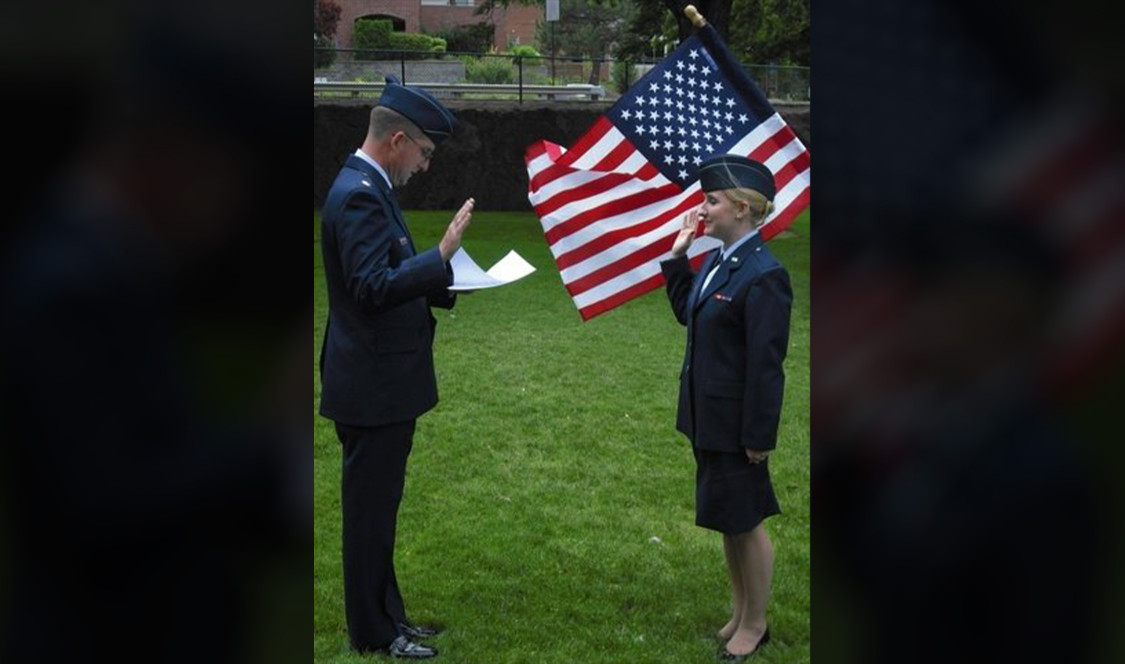
Kendra Henderson ‘09 comes from a CMC and military family. She is the oldest and has one sister (Liesl) who did not attend CMC, and two twin brothers who did, Remington Henderson ‘14 and Cortland Henderson ‘14. The two brothers served in the Army and love to kid their “old sister,” that she was in the Air Force. It is a close family network and the twin brothers are very protective of their “older sis!” And, to top it off, their father, Robert Henderson ‘80 is also a CMC grad who served for 20 years in the Air Force, retiring as a Lieutenant Colonel.
The family comes from a small, rural town in southern Oregon, Klamath Falls (population 20,000+). Her high school had only 112 graduates. From an early age, Kendra knew she wanted to be a physician. She enjoyed dissecting fish and studying the anatomy of animals that the family brought home from hunting trips. She has also had a deep-rooted desire to help those who are ill or are in need of comfort.
Kendra came to CMC somewhat because of family tradition, but also because it has a reputation for training in the sciences and preparing students to become physicians. Access to a liberal arts curriculum was also important in her decision making. CMC turned out to be a formative experience for Kendra. It opened her mind, broadened her experiences, and brought her in contact with a wide range of different people from what she was accustomed. As somewhat of an introvert, she was forced to open herself to life experiences. She remembers Professor Robert Valenza, who taught Calculus, had a significant impact on her - not so much for the math but for the liberal arts applications he brought forth in his classes about art, humanities, and philosophy. In her second semester she bombed a Calc test for being unprepared. She went to him distraught and cried over the failure. He had her retake the test on the spot, and she passed – thus demonstrating this professor’s caring professionalism. Professor David Sadava, her biology professor, was also influential. He dedicated himself to cancer research after his first wife passed away from the disease and turned the tragedy into making life better for cancer patients. He demonstrated passion, encouragement and instilled the belief in Kendra that “you can do it.”
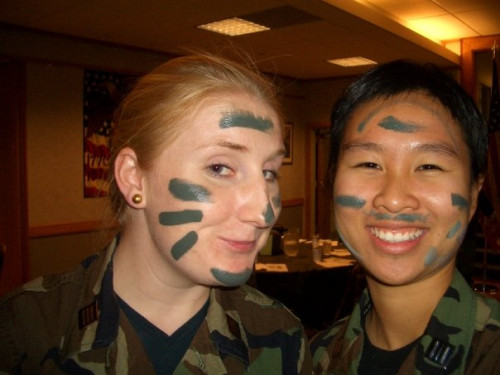
Kendra opted for Air Force ROTC at CMC, influenced in part by her father’s career. She spent every Friday at USC taking AFROTC classes. Her CMC professors, fortunately, accommodated her schedule, and an ROTC scholarship from CMC helped pay the bills. With such a demanding schedule, there was little time for many activities. She did run cross country track in her freshman and sophomore years but could not dedicate sufficient time to the sport to become a contender. She was adept at running 5Ks however and never had to worry about taking a PT test in ROTC or when on active duty. Kendra is reminded of two distinct experiences at CMC. Somehow her father got the names of some senior students and let them know it was Kendra’s birthday. They grabbed her and introduced her to “ponding.” She never knew who the students were or saw them again! She also recalls her senior thesis story. It was tradition in those years that when a student turned in their senior thesis, they were given a bottle of champagne! (A wonderful tradition of the day that sadly no longer exists!) Kendra drank the entire bottle of champagne to celebrate and then went to her class at Pomona. Somehow, she managed to give the presentation she was responsible for that day!
Upon graduation and commissioning as a second lieutenant in the Air Force in May 2009, Kendra was told there would be a delay in reporting for duty. She came home and worked as a waitress in a public country club. It was a stressful and disheartening experience. Here was a young woman who had just graduated with a college degree and commissioned as a second lieutenant in the Air Force waiting tables at an affluent country club. While it was a humbling experience, the work turned out to be one of her most memorable experiences and one she frequently reminds herself of when she is in the ER and being slammed with patients. Waiting tables taught her to be patient and kind to people in the ER when they are angry after waiting six hours to see a physician. She has learned to put on a smiling face even when she sees trauma patients coming through the ER doors. She has learned to prioritize and triage the most critical patients (rack ‘em and stack ‘em!) She has learned to stay nice even if mistreated, and she has learned to listen and ask questions to help understand a patient’s fear, frustration, and pain. Kendra also learned from an experience when waiting tables how to open an expensive bottle of champagne and not spray the group of golfers who ordered it!
Finally, after 7 months of waitressing, Kendra was ordered to Goodfellow Air Force Base in San Angelo, Texas for Intelligence Officer training. Her course was only 7 months, but she was on casual duty for two months until the next class began. It was hot at Goodfellow with average temperatures in the 90s. The base was located near a polluted lake called Lake Naswater that everyone called Lake Nasty Water. They drank bottled water and Kendra, as the youngest, was tasked with the responsibility for carrying two 30 lb. containers of water to be shared among the others.

Most of her training was spent in a “SCIF” (Sensitive Compartmented Information Facility) where the officers trained and prepared to become intelligence analysts. They needed to be able to access and analyze and brief higher-ups about highly classified documents. Kendra was curious about how much classified information she could access and tried to research Area 51 and UFOs only to learn that that information was not available.
After 7 months, Kendra was assigned as an intelligence officer to the 30th Airlift Squadron in Cheyenne, Wyoming. Six months into her new job she received deployment orders, sending her to Kandahar, Afghanistan, assigned to the 451st Air Expeditionary Wing. She did some flying in C-130 aircraft with her squadron, but most of her time was spent giving daily intelligence briefings to the air crews about weapons, capabilities, tactics, and political developments. She was pleased with her assignment and felt she was doing the important work she was trained to do. On one occasion, as a 21-year-old Second Lieutenant, she was chosen to give a briefing to a Lieutenant General (3 Stars) who came to her headquarters. It was a stressful experience, but she must have done an excellent job because after it was over the general gave her a “challenge coin.” This was a stressful time for Kendra’s mother as well. One time when she was talking with her mother on a Satellite phone, the base came under mortar attack. She had to quickly tell her mother, “Sorry, Mom, we are under attack, and I have to run for the bunker. I will call you back!”
After deployment, Kendra returned to Wyoming and in 2014, completed a Master of Arts degree in molecular biology. Her desire to become a physician had not waned while in the Air Force. She might have wanted to remain in the military but desired more control over her life than the Air Force would allow and left the service after four years of active duty as a 1st Lieutenant, right before being promoted to Captain. Overall, she believes the experience was a profitable one and she came away having developed the skills of briefing and advising senior officers.
The next step on Kendra’s journey was to Twin Falls, Idaho, where she worked in hospital administration for a year. There she met her husband, Ryan Mathews, first online and then in person. Ryan was also in the Air Force and after long conversations they discovered that Ryan’s father, who had also been in the Air Force, had worked for Kendra’s father at one time. Small world!
From Idaho, Kendra applied and was accepted at Eastern Tennessee State University, one of the seven med schools in the country with a government funding requirement to train doctors in family medicine to work in VA hospitals. Kendra was able to negotiate in-state tuition and moved to Tennessee. Meanwhile, her husband received an assignment to Portugal. Kendra expected the class work at ETSU to be hard, but it turned out to be even harder than she anticipated. Hours were long and there was lots of study, but her CMC and Masters training had prepared her well, so she dug deep and did the work. For example, she had done extremely well in molecular biology at the University of Wyoming and knew the subject well but found that ETSU covered her previous years' worth of material in one month! The hard work was frequently balanced during semester breaks with trips to visit her husband to tour Portugal and other countries.
After 4 years at ETSU, Kendra received her Doctorate of Medicine degree and initially matched to residency at ETSU Family Medicine in Bristol, TN. Starting residency during the early days of the Covid pandemic caused her to reconsider her options. She discovered a deep interest in critical care in addition to working with the wide variety of medical problems in family medicine, so she changed specialties halfway through residency. She and Ryan moved to Portland to pursue a residency in Emergency Medicine at Oregon Health Science University.
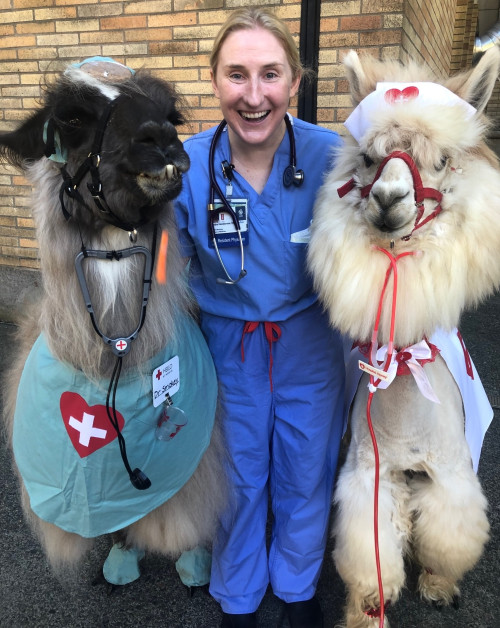
Kendra has remained in the ER at OHSU for the past four years. Her days and shifts are never the same. Some days she works from 11AM to 7 PM and some days she has the night shift. She sees and has seen every type of situation in the ER with the most common conditions being chest pains, shortness of breath, COPD, pneumonia, dizziness, stroke, and abdominal problems.
She has had her share of unusual cases too, from beans up children's noses to foreign objects inserted into adult bodies. She has experienced gunshot wounds, stabbings, and the results of gang violence. She has met nice people with aches, pains, and unexplained problems. And she has experienced death, usually once per month. She finds it satisfying to be able to stitch up a laceration expertly leaving little or no scar. She takes pleasure in talking with patients, listening carefully, holding their hands, diagnosing problems, and giving grace, advice, and reassurance when possible. The hardest job, of course, is telling a family that their relative or family member has died.
Sometimes she must dig deep, put on that happy face from her waitress days, and visit an angry patient who has been waiting for six hours while she tried unsuccessfully to save someone's life. On one occasion an elderly man came into the hospital experiencing chest pains. He had been trying to get to another hospital where his wife had been admitted. Kendra tried to get the man transferred to the other hospital so they could be together. The other hospital was full and would not accept him. Unfortunately, by the time the man was eligible to be transferred his wife had died. It was a tough experience. Kendra’s home is her free space with her husband. Sometimes she must unburden herself to him, but she always tries to leave her work and the troubled times at the hospital.
Moving forward, Kendra plans to stay at OHSU for the foreseeable future. She finds the work satisfying and learns new skills from recently trained physicians coming to the ER. She continues to work on her tennis game, practices her Spanish and paints a mean picture. She concludes by saying “she is happy, fulfilled, contributes, and feels this is where she was meant to be.”
Kendra offers the following Life (Saving) Lessons Learned – some valuable takeaways for all:
- If you take care of people, they will take care of you. Pay attention to your people, protect, listen, and understand their issues. You do not always have to solve their problems. Sometimes they just need someone to listen.
- Learn that experiences that do not work out are learning experiences that impact life. We can learn from failures and difficult experiences (i.e., being a server) if we allow ourselves to do so.
- Be willing to give grace, patience, and advice to others. They will give it back to you.