

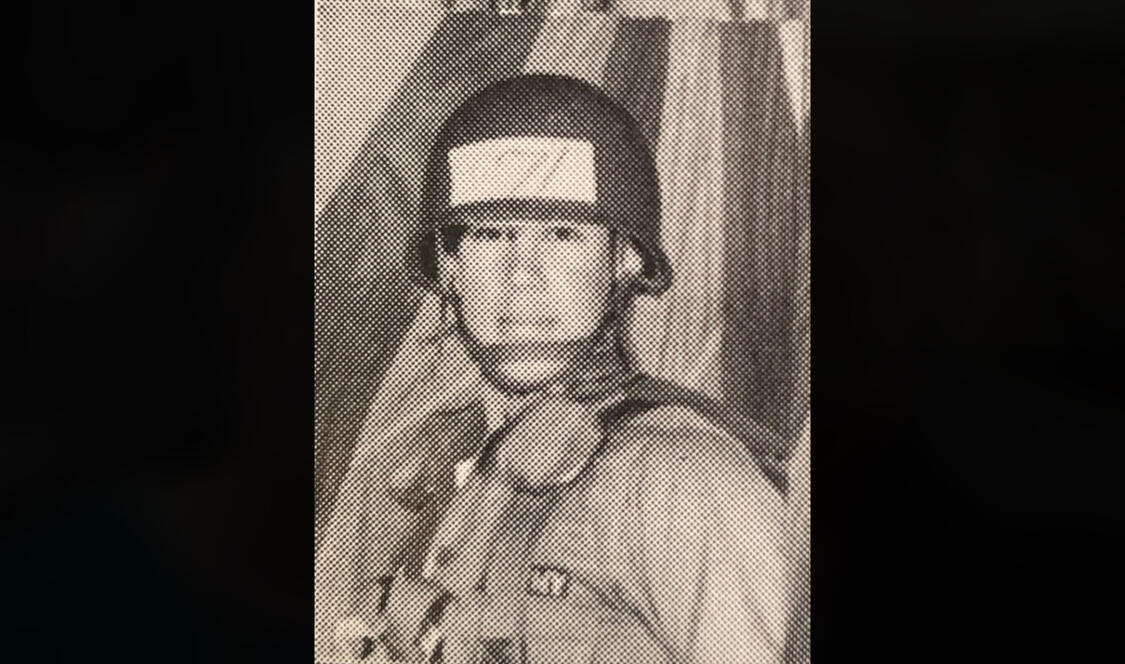
In January 1965, after completing Basic Officer Training at Ft. Lee, VA, and Jump School at Ft. Benning, GA, Larry Berger ‘64 received orders assigning him to a stateside post. He inquired of his branch if a more interesting assignment might be available and was told “you can always go to Korea.” He thought about it and said, “I’d like to know more about Korea.” He then embarked on a journey that would impact the rest of his life and career.
Larry was placed on the waiting list at Stanford and decided not to wait, joining two high school friends to come to CMC. He wanted to continue playing football. He was fast and had great hands. He played end and joined the freshman team for a winning season except for the final game against Pomona – a heartbreaker!
He majored in Political Science and International Relations and enjoyed classes from Professors Fisk, Diamond and Rood who was his thesis advisor. He made good grades and took advantage of the semester abroad program spending the summer after his freshman year working for an NGO in London and between his junior and senior years in a cultural program in Austria and Switzerland. The experience reinforced his commitment to study international relations and his enthusiasm for European culture and history. His senior thesis explored the meaning of nationalism, using the case study of the Southern Tyrol/Alto Adige.
In his sophomore year, Larry switched from football to track and soccer. He was active as a dorm officer, Freshman Class Officer, and in the Knickerbockers. In his senior year he was honored to be elected to the Pi Sigma Alpha, National Political Science Honor Society, nominated by Professors Fisk and Rood.
Graduating and commissioned as a Second Lieutenant in July 1964, the Army recognized his international relations expertise and assigned him to the Civil Affairs Branch. After basic officer training and a three-week stint jumping out of airplanes at Ft. Benning, GA, he was assigned to the 8th US Army (EUSA) Support Command in Uijeongbu, Korea. There he was responsible for the soldiers that staffed an exceptionally large depot under the direction of a major. The areas of responsibility included transportation, quartermaster, ordinance, and EOD. He was 22 years old. Larry comments that, “It was a very exciting experience.” One of these exciting experiences was dealing with a PFC who requested to see him and explained that “he was in love.” The lady in question was a Miss Kim, whose profession was as a "Lady of the Evening.” Larry took time to explain to the young soldier that this relationship was not in his best interest. Larry decided to extend his military service and was transferred to the Headquarters Company of the 8th US Army Headquarters in Seoul. In the spring of 1965, with Vietnam heating up, he was first assigned as the Executive Officer of the company but was soon promoted to Company Commander responsible for 200 soldiers and numerous civilian workers and contractors. He continued to work and live in East Asia from February 1965 to the present.
In September 1966, Larry completed his active-duty service and went to UC Berkeley to pursue an MBA degree receiving credit for military service and coursework he completed at CMC. He majored in International Finance and Corporate Finance. His master's thesis was “The Impact of Financial Institutions on the Rate of Economic Growth using Korea as a Case Study.” (At the time Korea was one of the poorest countries in the world, but now 75 years later it is one of the richest and one of the 10 largest economies in the world.) Larry then began a 20-year career with J P Morgan. There were 25 new JPM management trainees in 1968 and all of them took a five-month course in banking and corporate finance. The course was led by a professor from Columbia Business School. He also found time to marry his first wife.
The next four years were spent with J P Morgan, first in New York and then assigned to the Tokyo Office Corporate Banking Team that was experiencing rapid growth. During this time, he made several trips to Seoul and communicated with management about the need to increase JPM’s presence in Korea. He was in the right place and at the right time; his work was recognized, and he was promoted. While Korea was 10-20 years behind economically, indications were that the economy was about to blossom. He was brought back to New York to make a presentation to the J P Morgan Board of Directors to develop the bank’s business in Korea. The BOD proposal was accepted, and he was tasked with the responsibility of opening a branch in Seoul and building a business presence for the company in Korea.
Larry worked 6-7 days a week to build a new Korean business enterprise. He selected good people and built strong teams. It was during this period that he realized the importance and value of maintaining close and lasting relationships – a talent he nurtured and developed throughout his successful financial services career.
After six years in Japan and three in Korea, and while he wanted to remain in Korea, but was pressured to returned to work on Wall Street responsible for the trading desk in Capital Markets. This was a new experience for him, and he profited from learning new skills. It was the mid 80s and after 20 years, Larry left J P Morgan and began a second 30-year career with McKinsey & Company. He returned to live and work in East Asia. He remarried to an Indonesian lady and served McKinsey’s clients in Indonesia, Japan, Korea, China, Singapore, and Thailand building long-term client relationships.
Today, Larry enjoys a continuing relationship with McKinsey, taking advantage of the many relationships he has built over the years with various bankers in Asia. He maintains close relations with senior banking officers and maximizes past relationships to continue driving McKinsey’s business strategy. Larry views his 20-years with J P Morgan and 30 with McKinsey & Company as the bookends to his successful financial services career all created by a chance decision made in 1964 when choosing a military posting to Korea.
On the personal side, Larry enjoys extensive travel and organizes family get-togethers with his three children and 8 grandchildren twice a year. The families have traveled together in Japan, Southern Africa, the Mediterranean, Continental Europe, Scandinavia, the British Isles, Indonesia, and East Africa. Larry and his wife Diana, have a family home in Grand Lake, Colorado, which has also been the scene of many memorable family gatherings. Larry maintains close relationships with many of his 1964 CMC classmates including Marshall Jarvis, Bill Dawson, Steven Hallgrimson, Steve McClintock, Doug Noble, John Taylor, and Gil Ferry. Larry has traveled with Marshall and Bill on carefully planned and executed trips to Egypt, Israel, Galapagos, Sicily, Greece, Southern Africa, Baffin Island/Greenland, and Morocco.
When at home in Orinda, CA, Larry and Diana, divide their gardening enthusiasm duties. Diana is a keen home gardener whose specialty is flowers, and Larry is focused on plants, trees, and vegetables. Larry remains electronically connected and manages the home office for the family. He notes that one of his granddaughters is a top water polo athlete and is currently speaking with college water polo coaches about the next steps. Larry is hopeful that CMC will be in contention based on the recent success of the women’s team.
Larry summarizes his life experience by stating that in his bookend company experience with both JPM and McKinsey he has seen incredibly brilliant people hired who understand how to provide advice, but brilliance alone is not enough. One must be able to work with others to achieve success. He has seen some bright people who are great at solving problems but cannot network and build teams and have been unsuccessful in their careers.
Larry’s Life Lesson’s Learned are as follows:
1. Education opens the door. The time spent at CMC and Berkely gave him the discipline to sustain his career.
2. Maintain focus and discipline. This has been a continuing theme in his life and has helped him to get results.
3. Team Building and Networking. The ability to work with others and build teams has been responsible for much of his success.