
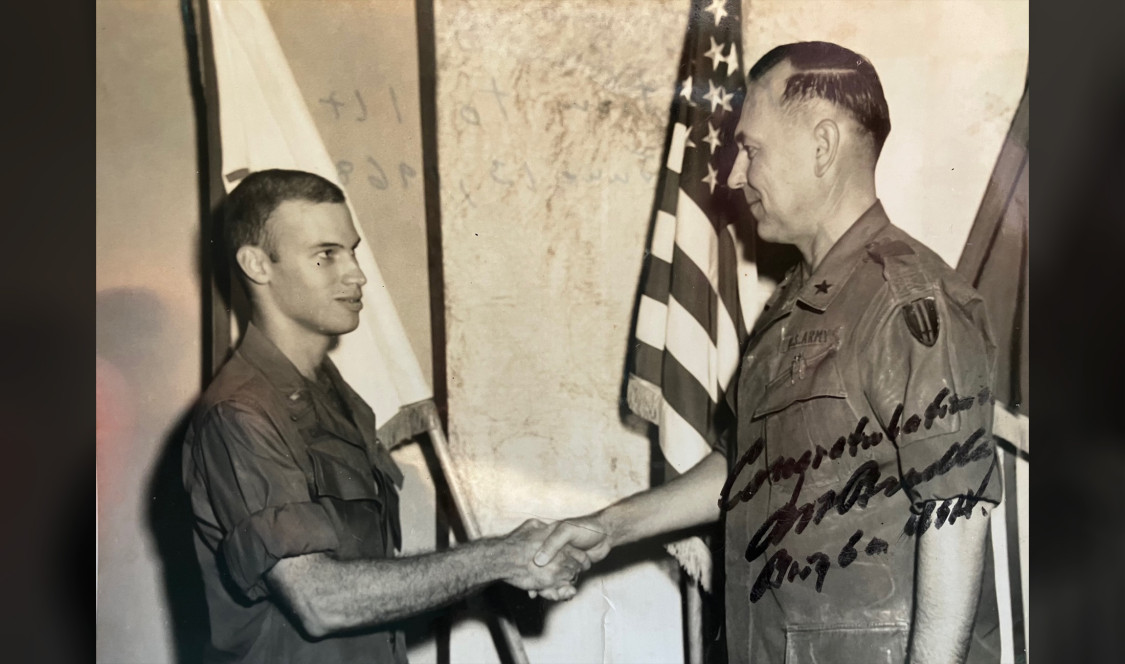
Philip Chrones ’66 defines himself as a boring person and a straight arrow. He has never smoked. He does not drink. He is not a partygoer. He is a deeply religious man. He is not gregarious, keeps to himself and his family. But Philip agrees that his career path has been dramatically altered by many people who have come into his life at opportune times. His military and civilian careers and the paths he has taken in his life revolve around the influence and help these people have given him.
Philip Chrones ’66 was born and raised in Hawaii. He attended Punahou High School as have many alumni who have come to CMC from Hawaii. He has always been interested in the military and attended Junior ROTC while in high school. He wanted to go to college on the west coast and saw that many graduates from his school had gone to CMC, so the choice became obvious.
When Philip started at CMC in 1962, the war in Vietnam had started to escalate. He joined ROTC with the knowledge he would be a leader and an officer. On his first day in uniform, on the parade field at Pomona College, Philip wanted to give a positive impression to the senior cadets who were teaching him the basics of military drills. Suddenly, his eyes started to water, and nose ran uncontrollably since the grass had recently been cut. He could not see. His uniform was wet and his first parade day in ROTC was a disaster!
Philip became a math major at CMC but struggled with advanced calculus. He was in danger of failing and not graduating. A freshman classmate came into his life and said, “I’ll help you pass.” Philip passed the course. His life path changed, and he graduated from CMC in 1966 and ROTC. He chose Engineer Corps for his branch which the Army altered to “Combat Engineer.” He then took a deferment from active duty and went to work for IBM in Los Angeles as a programmer. After a year with IBM, the Army called him to active duty, and he traveled to Ft. Belvoir in Virginia in June 1967. He did not like Virginia. Philip was a Hawaiian and liked warm weather. Virginia was cold and dreary. Pressing on, Philip dutifully completed the Basic Officer Engineering Course. He learned bridge building, demining operations, and the responsibilities likely to be assigned to a newly minted Engineering Second Lieutenant in support of Infantry and Armor units.
At the end of the course, Philip learned he was to be assigned to South Korea. While this assignment would have kept him out of Vietnam, Philip said “No, I want to be assigned to Vietnam.” His reasoning was basic: lieutenants assigned to South Korea spent their time riding along the DMZ (Demilitarized Zone) in jeeps, blown up by mines, shot at by North Koreans, received no combat pay, and it was cold! He chose combat pay, mines and heat and was rapidly reassigned.
Arriving in Bien Hoa, Vietnam in September 1967, Philip spent several days at the Replacement Depot waiting for his assignment. He was approached by a Colonel responsible for a statistics unit. The Colonel learned Philip had been a math major and told him: “you’re now working for me!” Philip found himself transferred to Long Bien, only a few miles away, and working in a statistics section. Another person had suddenly entered his life and changed his career path. He worked with two other lieutenants, did not understand the work, and hated his job. He was a programmer not a statistician. After two months, another lieutenant assigned to a nearby computer unit approached him. This officer hated computers and suggested they trade jobs. Philip was thrilled, but when he approached his Commanding Officer, he was told that he would have to finish a large pile of work that had been assigned to him before he could transfer. The other officers in his unit took pity on him, helped him complete the work, and allowed him to transfer to the programming job. Again, people had come into his life, to help, and alter his life path.
Philip enjoyed his new work, programming in Fortran and Cobol. The job of his unit was to track the construction and field improvements of military units throughout South Vietnam. A monthly survey report provided details of every man-made structure, from fox holes to fire bases and Quonset Huts to latrines. The information and updates were keypunched into a computer and created reports that were sent back to Congress to substantiate the war expenditures they had authorized.
Philip’s life changed again when he was approached by an Airforce Officer who suggested he spend $25 and join him in attending a course to learn to speak Vietnamese. He took the course and became proficient in basic phrases. Philip learned there were lots of birthday and going-away parties going on almost nightly at the Officer’s Club with lots of food and drink. One problem was that they could not get fresh bread for sandwiches. Because he spoke some Vietnamese, Philip volunteered to go off base and find a local baker and buy fresh bread. Philip became “the bread man” and was invited to attend all the parties at the O Club. While Philip did not drink, he brought fresh bread to all the parties and provided a valuable service.
Learning to speak Vietnamese also brought his future wife into Philip’s life’s path. He lived in a Quonset Hut and local Vietnamese women were hired to wash officer’s clothes and clean their quarters. The women would have lunch together each day and Philip felt this was an opportunity for him to practice his language skills. He met several cleaners who found him to be a nice person. One woman told her friend, Ha Thi that Philip was someone she should meet. Ha met Philip and after a while traded assignments so she could take care of Philip’s clothes and room. The couple spent many hours together and eventually fell in love.
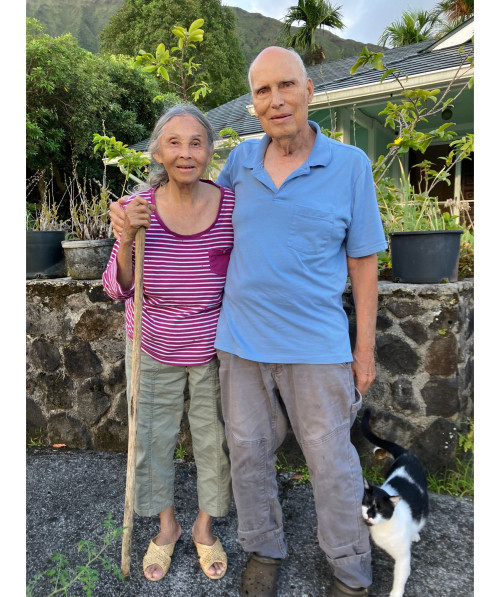
Philip’s tour was up in June 1969, and he returned to the U.S. having completed his active-duty requirement. He went back to work for IBM and requested to be assigned to Vietnam. He returned to Vietnam in August 1969, for an 18-month assignment working exactly where he had been before in Saigon. This time Philip had a chance to travel and enjoyed trips to Hong Kong, Australia, Thailand, and Sri Lanka. He and Ha resumed their relationship and were married in December 1969. Ha had a son from a previous marriage, and the couple’s first child was born in Vietnam. As the war intensified, IBM advised Philip to get his family out of the country. He spent weeks going from one South Vietnamese Government Office to another, filling out forms - only to be told that he needed to go to another office and complete another form. The U.S. Embassy was also concerned and resisted allowing American to marry locals made it exceedingly difficult for them to leave the country. Finally, in March of 1970, the paperwork was complete, and Philip was allowed to return to the U. S. with his wife and two sons.
After returning, he met with the IBM Human Resources Department in Honolulu and was told his next assignment would be in Washington, D.C. Philip’s response was, “No…too cold!” and asked about Hawaii. IBM had nothing for him there and he parted company with IBM and moved his family to Honolulu where he worked for a Doctor’s Association in their data processing department. The family had little money and Philip drove a motorcycle carrying reports between two offices. After two years, Philip’s boss was killed in a home invasion, and his new boss was someone he felt he did not want to work for. He resigned and took a job with First Hawaii Bank doing Computer Systems Design. He worked for the bank for the next 30 years, retiring in 1982.
Because the family had little money when they moved to Hawaii, Ha began to plant Vietnamese vegetables in her small garden plot and sell produce in Chinatown to restaurants and stores who wanted the unfamiliar delicacies. Her plantings soon grew larger as she took over several neighbors' yards. She raised highly sought after Vietnamese vegetables. These vegetables were in demand by the Vietnamese who frequented the Vietnamese restaurants in Honolulu. Ha was also an excellent cook and often would join in the parties herself. She became an entrepreneur, her business flourished, and she began exporting to the U.S. mainland. Philip’s job was to deliver the produce within Honolulu and to the mainland. Ha also opened a successful restaurant in Chinatown, but having both the farm and a restaurant was too much for her so she sold the restaurant after 2 years.
The family bought a house on the ridge of the Salt Lake volcano with an amazing view of Diamond Head in one direction and Honolulu harbor in the other. The home had 33 steps to the front door and when Ha became pregnant with their third child, she told Philip the steps were too many, and it was time for them to move!
In 1982 Philip began planning to bring family members from South Vietnam to the U. S. including a niece, 3 nephews, his mother-in-law and brother-in-law. His mother-in-law missed taking the boat and remained in Vietnam and soon passed away. The family members came to live and helped Philip and Ha. Philip attributes Ha’s entry into his life with the ultimate success he and his family have enjoyed: “We would not be where we are today without Ha. It has been a partnership directed by Heaven.”
While Philip remains a “straight arrow,” he cites the following Life Lessons Learned as having attributing to his life path:
- His life had been guided by his religion and faith.
- People came into his life at opportune times and changed his path - always for the better.
- His oldest son has adopted him and calls him Dad.
- He is fortunate to have found and married a life partner who has brought love and success to his family.